if / else blocks
A condition guards one request. A block guards a group of them, with optional else and else if arms — so a case can branch on a response without being split into separate files.
Wrap some requests
- Select the requests the condition should govern — click one, or Shift-click a range.
- Right-click and choose Wrap in an if / else…
- Build the condition and confirm.
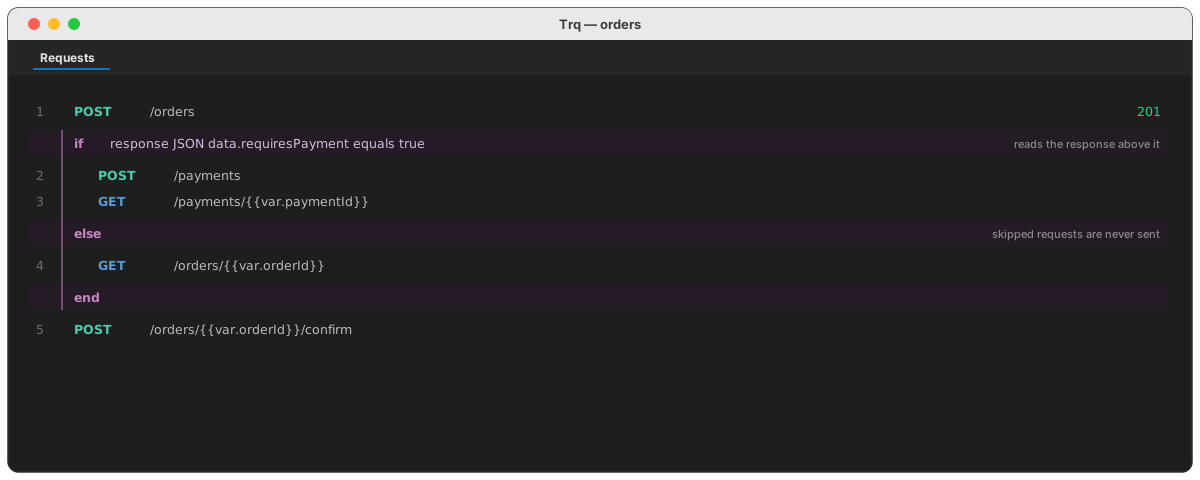
An if marker, your requests indented beneath it, and an end marker. Requests between them are sent only when the condition holds; anything after end always runs.
Add the other arms
Right-click the if marker:
| Menu item | What it does |
|---|---|
| Edit condition… | Change what this arm asks |
| Add else | A final arm, for when nothing above matched |
| Add else if… | Another condition, tried in order, before any else |
| Remove the if / else (keep requests) | Delete the markers; the requests stay, unguarded |
:::caution Before 2.9.0
An else if arm never matched. Its condition was not evaluated, so the else arm always won instead. If you are on 2.8.3 or earlier, either update or use a nested if / else until you do — a plain if / else was never affected.
:::
Arms are tried top to bottom and at most one runs. Once one matches, the rest are skipped without being evaluated.
Once an else exists, both Add else options switch off — an arm after the catch-all could never be reached.
What a condition can read
The same four sources as a per-request condition:
| Source | Example |
|---|---|
| Response status | status is 200 |
| Response JSON path | data.status equals complete |
| Response header | x-order-state equals shipped |
| A value or variable | {{var.plan}} equals pro |
A block's condition reads the response of the request before it — the same one a per-request condition on that position would see. See Conditions for the operator list.
What a run looks like
Requests in an arm that didn't run are marked skipped rather than failed, and say which condition skipped them. They are not sent — no call leaves Trq.
Markers don't count as requests. A case with nine requests and two blocks still reports nine, and the if / else / end rows never appear in a report as passing or failing.
An example
Only verify a payment when the order actually needs one:
1  POST /orders                     → 201
   if  response JSON  data.requiresPayment  equals  true
2    POST /payments
3    GET  /payments/{{var.paymentId}}
   else if  response status  equals  202
4    GET  /orders/{{var.orderId}}/queue
   else
5    GET  /orders/{{var.orderId}}
   end
6  POST /orders/{{var.orderId}}/confirm
Requests 1 and 6 always run. Exactly one of the three arms runs between them.
Nesting
Blocks nest, and a block inside a skipped arm is never evaluated — its condition would be reading a response that was never fetched.
Half-authored blocks
An if with no condition takes its else arm rather than guessing, so a marker you haven't finished never silently sends its requests. A stray end is ignored rather than failing the case.
See also
- Conditions — guarding a single request
- Variables — capturing values for a condition to read
- if / else blocks for web — the same feature, same implementation
- Conditions for mobile — the same structure, asking about a screen